The Cost of This Job
We're not going to throw a number at you here, because a spring job on a builder-grade door from a 2003 build isn't the same job as an opener swap on a heavier insulated door from 2015. Torsion spring size, door weight, cycle count, and whether the drum or cable needs replacing too all move the price. What we can tell you is how we price it: we look at the door in front of us, tell you what's actually worn versus what still has life in it, and give you a number before we touch anything. If a part's still serviceable, we don't replace it just because it's convenient. That's the honest version - anyone quoting you a flat number sight unseen for a McKinney home built any time between 1971 and 2015 is guessing, because the hardware generation on that door matters more than the year on the permit. Ask what's failing and why before you ask what it costs, and a shop that can answer the first question is one that'll get the second one right too.
What Causes It Around Here
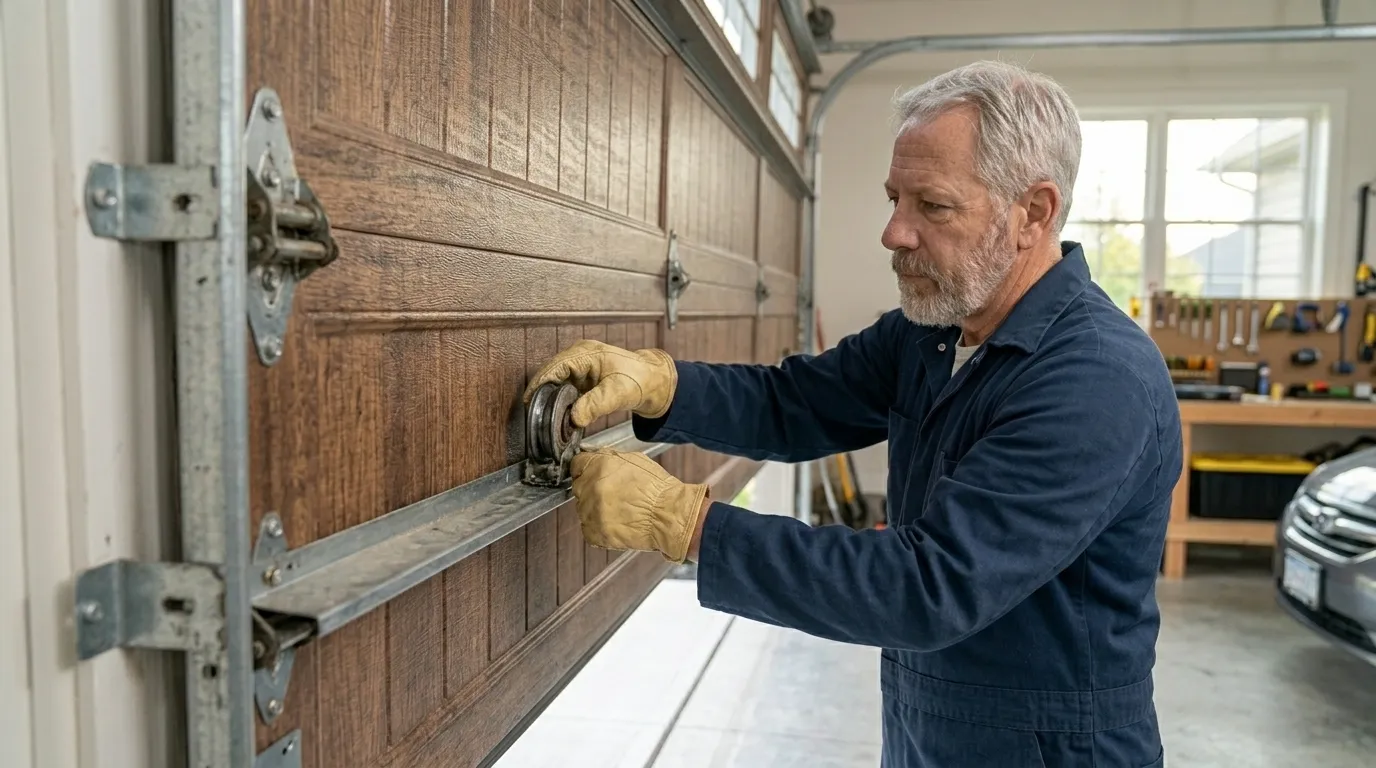
Most of the housing stock across McKinney's service area went up between 1971 and 2015, with the median build year sitting around 2005 - meaning a huge share of the doors on the road today came in during that 2000s building push across the area's 19 named neighborhoods. That matters because torsion springs are rated for a set number of open-and-close cycles, not a set number of years, and a door installed in the early-to-mid 2000s is now well past the point where the original spring should still be doing the job. Add in the moderate-heat climate band McKinney sits in: steel expands and contracts with daily heat swings, and that constant flexing fatigues spring coils and dries out lubrication on rollers and hinges faster than a mild climate would. So you get a specific pattern here - a wave of doors from the same build era, hitting the same cycle-life wall, made brittle faster by heat cycling than the spring's rated lifespan would suggest on paper. It's not that McKinney doors are built worse. It's that so many of them were built in the same fifteen-year window, and they're aging out together.
The Complications
The complication with the springs-and-opener wave hitting a lot of 2000s-era McKinney doors at once is that people tend to keep hitting the wall button through the early warning signs, and a motor that keeps straining against a dead spring eventually cooks itself. At that point you're not looking at a spring job anymore, you're looking at a spring job plus an opener. Across a service area with roughly 40,679 households and 31,785 owner-occupied houses, that's a lot of garages running original opener logic boards that are simply old enough now to be near the end of their run, independent of the spring issue entirely. With median household income here at $109,528, we see more owners choosing to replace the whole opener once it's compromised rather than patch a board that's already on borrowed time - that's a reasonable call, but it's a different job and a different bill than the spring alone. The honest limitation: if your opener's original to a mid-2000s install and the board's already flaky, we're not going to sell you a spring-only fix and pretend the opener will hold. We'll tell you what's actually failing before we start.